

Ethan Brooks
Focused on sustainable practices, careful seed selection, and hands-on experience, our family work closely with nature to produce quality harvests while continuously learning and improving each year..
Latest Posts
- DIY Aquaponics: How to Build a Backyard Fish and Vegetable System

- Fish-Friendly Fertilizers: What Is Safe to Add to Aquaponics and Garden Ponds
- DIY Aeroponics: How to Build a Low-Pressure Aeroponic System at Home
- How to Grow Mulberry Tree A Simple Guide for US Gardeners
- How to Grow Tulip Tree A Friendly Guide for Beginners


Archive
Tags
Social Links
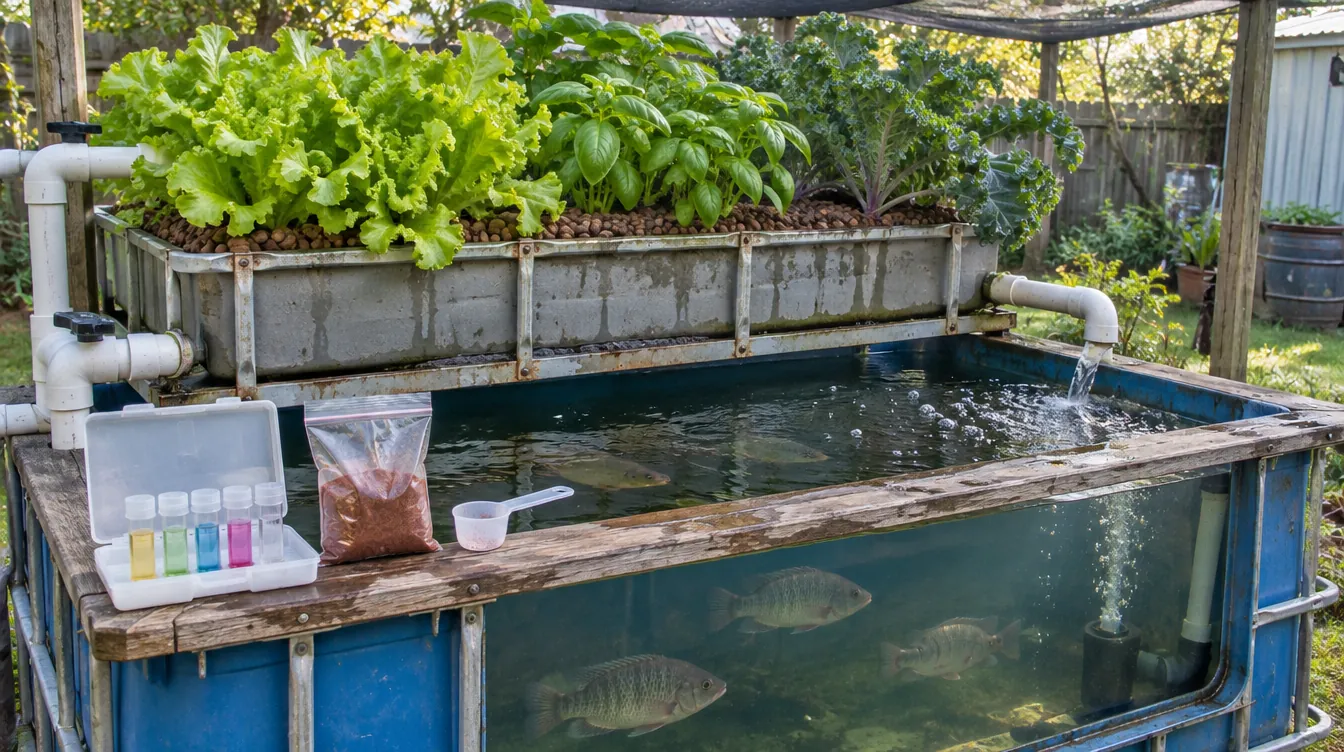

Fish-friendly fertilizers are nutrients you can add to water that fish live in without harming them. In an aquaponics system that usually means three supplements: chelated iron (Fe-DTPA), calcium, and potassium. Calcium and potassium are added as calcium hydroxide and potassium hydroxide, which also raise pH. Regular garden fertilizers, anything containing copper, and sodium-based pH products should stay out of the water.
This guide explains why fish waste alone is not enough for plants, which supplements are safe and how much to use, what to avoid, and how to protect a garden pond from fertilizer runoff.
Why fish waste is not a complete fertilizer
In aquaponics, fish produce ammonia, bacteria convert it to nitrate, and plants take up the nitrate. That covers nitrogen well. But fish feed does not contain enough of every nutrient plants need. Extension guidance from Florida notes that calcium, potassium and iron are not present in fish feed in adequate amounts and must be added separately. Iron is the one most aquaponic gardens run short of first, which shows up as yellowing between the veins of new leaves.
The catch is that anything you add goes straight into the fish tank. So the right supplement has to feed the plants without stressing the fish or the nitrifying bacteria.
The three fish-safe supplements
1. Chelated iron (Fe-DTPA)
Iron added in plain form quickly turns insoluble in well-aerated water and becomes useless to plants. Chelated iron is bound to an organic molecule that keeps it dissolved. New Mexico State University Extension recommends adding 2 mg/L of chelated iron every 3 weeks, or as needed.
Which chelate matters. Fe-DTPA stays available up to about pH 7.5, which suits most aquaponic systems. Fe-EDDHA works at higher pH but stains the water red. Aquaponic growers generally avoid Fe-EDTA, because it holds iron poorly at the near-neutral pH these systems run at.
How to dose: work out your total water volume in litres, multiply by 2 to get milligrams of iron, then divide by the iron percentage on the product label. For example, 1,000 litres needs 2,000 mg (2 g) of iron, which is about 18 g of an 11% Fe-DTPA product.
2. Calcium (calcium hydroxide or calcium carbonate)
Calcium hydroxide (hydrated lime) supplies calcium and raises pH quickly. Calcium carbonate (agricultural limestone) or dolomite raises pH more slowly and gives a longer-lasting buffer, according to University of Florida guidance. Add small amounts, dissolved first, and retest before adding more.
3. Potassium (potassium hydroxide or potassium carbonate)
Potassium hydroxide supplies potassium and raises pH. The University of the Virgin Islands’ long-running tilapia and vegetable system maintains its pH by alternating between calcium hydroxide and potassium hydroxide, so both nutrients get topped up as part of routine pH control.
Keep pH in the aquaponics sweet spot
pH decides whether these supplements work, and it is a compromise between three living things. Plants prefer slightly acidic water, fish tolerate a wide range, and the nitrifying bacteria that keep ammonia down work best above neutral. NMSU recommends keeping aquaponic water between pH 6.4 and 7.4, ideally 6.4 to 7. Research summarised by Florida researchers found that nitrification slows sharply or stops when pH drops below 6.
| Problem | Fish-safe fix |
|---|---|
| pH too low | Calcium hydroxide or potassium hydroxide, in small doses; calcium carbonate for a slower, steadier rise |
| pH too high | Small doses of phosphoric, sulfuric or citric acid, diluted first |
| Iron deficiency (yellow new leaves) | Fe-DTPA at 2 mg/L |
| Calcium or potassium deficiency | Use the matching hydroxide for pH correction |
High pH has a second cost: it makes ammonia more dangerous. NMSU’s figures show that at 82°F, about 2% of the ammonia in the water is in the toxic form at pH 7.5, compared with 18% at pH 8.5. Never raise pH quickly in a tank with an ammonia problem.
What to keep out of a fish system
- Regular garden fertilizers. Many contain ammonium salts that add ammonia directly to the water, plus ingredients that were never tested for fish safety.
- Anything with copper. Copper is toxic to fish, and it gets more toxic as water alkalinity drops. UF/IFAS Extension advises against copper treatments altogether when total alkalinity is below 50 ppm. Check the labels of micronutrient mixes and fungicides.
- Sodium-based pH products. Sodium hydroxide and sodium bicarbonate work, but neither plants nor fish take up sodium, so it builds up to harmful levels over time. UF/IFAS lists them as poor choices for aquaponics.
- Galvanized pipes and fittings. They release zinc, and Iowa State notes that copper and galvanized pipe together can form compounds that are fatal to fish.
- Pesticides and leaf shines sprayed over the grow beds, where drift and runoff land in the water.
Foliar feeding: nutrients that never touch the water
If you want to correct a deficiency without changing the water at all, spray the leaves. University of Florida extension describes foliar micronutrient sprays as a standard way to make up for what an aquaponic system lacks while keeping pH where the fish and bacteria need it. Spray in the evening, cover the water surface or angle the spray away from the tank, and use products without copper.
Protecting a garden pond from fertilizer
“Fish-friendly” matters outside aquaponics too. Fertilizer that washes from a lawn or vegetable bed into a garden pond feeds algae. Oklahoma State University Extension explains the chain: algae bloom, then die, and their decay uses up the dissolved oxygen fish need, which can suffocate them. Fertilizer runoff from lawns is one of the causes it lists.
- Leave an unfertilized strip of grass or plants around the pond edge.
- Use slow-release fertilizer, and never fertilize just before heavy rain.
- Sweep fertilizer granules off paving so they don’t wash into the water.
- Feed pond plants with aquatic fertilizer tablets pushed into the pot soil, not loose fertilizer in the water.
Frequently asked questions
Can I use regular hydroponic nutrients in aquaponics?
Not at full strength. Hydroponic nutrient mixes are designed for water with no fish and often contain salts that raise concentrations well beyond what fish tolerate. In aquaponics, add only the specific nutrients the system is short of.
How do I know if my aquaponic plants need iron?
Iron deficiency shows on the newest leaves first: they turn pale yellow while the veins stay green. Older leaves usually stay green. If you see it, dose chelated iron and check that your pH is not above 7.5.
Is seaweed or kelp extract safe for fish?
Many aquaponic growers use small amounts of seaweed extract as a potassium and trace-element source. Add it gradually, watch the fish, and test the water, because some products also contain other additives.
How often should I test the water?
Test pH and ammonia at least weekly once a system is established, and every day or two when it is new or after you add any supplement.
Sources
- New Mexico State University Extension, “Water Qualities in Aquaponics” and Circular CR-680, “Important Water Quality Parameters in Aquaponics Systems”
- University of Florida IFAS Extension, “Aquaponics pH” and “Foliar-Applied Micronutrients in Aquaponics” (HS1163)
- University of Florida IFAS Extension, “A Practical Guide for Aquaponics as an Alternative Enterprise” (HS1252)
- Orange County (FL) Extension, aquaponics fact sheet (2013)
- Tyson et al., “Reconciling Water Quality Parameters Impacting Nitrification in Aquaponics: The pH Levels”, Proc. Fla. State Hort. Soc. 117 (2004)
- University of Florida IFAS Extension, “Use of Copper in Freshwater Aquaculture and Farm Ponds” (FA-13)
- Iowa State University Extension, copper sulfate in ponds (PM1352i)
- Oklahoma State University Extension, “Copper Sulfate: An Often Overused Chemical in Pond Management”