

Ethan Brooks
Focused on sustainable practices, careful seed selection, and hands-on experience, our family work closely with nature to produce quality harvests while continuously learning and improving each year..
Latest Posts
- DIY Aquaponics: How to Build a Backyard Fish and Vegetable System

- Fish-Friendly Fertilizers: What Is Safe to Add to Aquaponics and Garden Ponds
- DIY Aeroponics: How to Build a Low-Pressure Aeroponic System at Home
- How to Grow Mulberry Tree A Simple Guide for US Gardeners
- How to Grow Tulip Tree A Friendly Guide for Beginners


Archive
Tags
Social Links
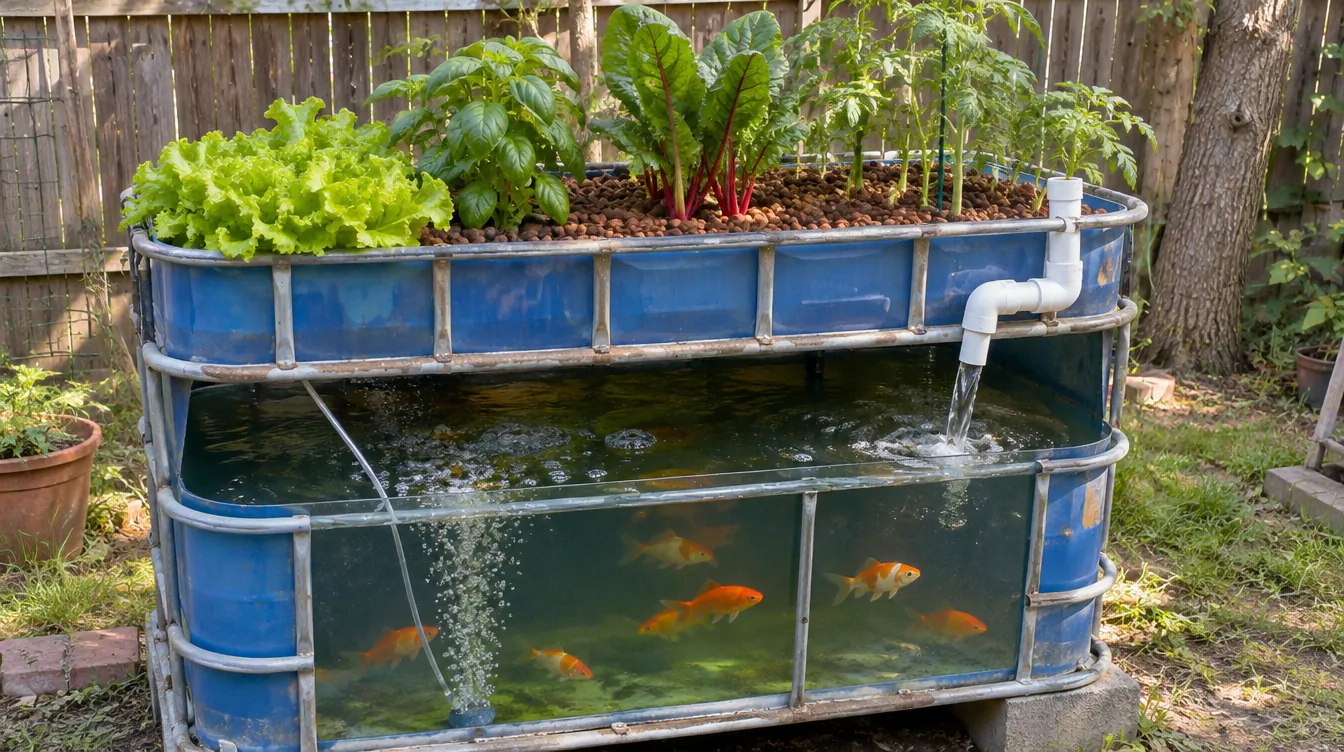

DIY aquaponics is a home system where fish and plants share the same water: fish waste feeds the plants, and the plants clean the water for the fish. The simplest version to build yourself is a media bed system: a fish tank, a grow bed filled with expanded clay pebbles above it, and a small pump that moves water between them. Once the bacteria are established, which takes about four weeks, it grows leafy greens and herbs with no fertilizer beyond fish feed and a few supplements.
This guide covers how aquaponics works, the three main system types, how to size your tank and grow bed, a step-by-step build, how to cycle the system safely, which fish and plants to choose, and the routine that keeps it running.
How aquaponics works
Aquaponics joins two things: raising fish (aquaculture) and growing plants without soil (hydroponics). Three living parts make it work:
- Fish eat feed and release ammonia through their gills and waste.
- Nitrifying bacteria living on the grow bed media turn that ammonia into nitrite, then into nitrate.
- Plants take up the nitrate as fertilizer, which keeps the water safe for the fish.
The bacteria are the part beginners forget. Ammonia and nitrite are toxic to fish; nitrate is far less so. Until a healthy bacterial colony exists, the system cannot protect the fish, which is why cycling (covered below) comes before anything else.
The three main system types
| System | How plants grow | Best for |
|---|---|---|
| Media bed | In a bed of gravel or expanded clay that also hosts the bacteria and catches solids | Beginners, mixed crops, fruiting plants |
| Deep water culture (raft) | On foam rafts floating on aerated water | Large quantities of lettuce and leafy greens |
| Nutrient film technique (NFT) | In sloped channels with a thin film of water | Light leafy crops, more experienced growers |
Oklahoma State University Extension describes all three for small-scale systems. A media bed is the forgiving choice for a first build, because the media does three jobs at once: it supports the plants, houses the bacteria, and filters out solid waste.
How to size a DIY aquaponics system
The balance that matters is between how much your fish eat and how much plant area you have. The FAO’s guide to small-scale aquaponics gives these working ratios:
- Feed rate: 40–50 g of fish feed per square metre of grow bed per day for leafy greens, and 50–80 g for fruiting vegetables.
- Fish density: 10–20 kg of fish per 1,000 litres of water, with 20 kg as the upper limit for new growers.
- Pump flow: its example system moves about 2,000 litres per hour through a 1,000-litre tank, roughly two full turnovers per hour.
Oklahoma State’s own guidance for new growers is simpler: plan for about one pound of fish per 10 gallons of water at harvest size.
Example: a 1 m² grow bed for lettuce needs about 40–50 g of feed a day. Adult fish typically eat 1–2% of their body weight daily, so that feeds roughly 2.5–5 kg of fish, which sits comfortably in a 250–300 litre tank.
What you need
- Fish tank: a food-safe container of 200–1,000 litres. A cut-down IBC tote is a popular low-cost option; make sure it previously held food-grade contents.
- Grow bed: a sturdy, food-safe container about 30 cm (12 in) deep, set above the tank so water drains back by gravity.
- Grow media: expanded clay pebbles or expanded shale. Oklahoma State recommends inert, porous, lightweight media like these because they give bacteria a large surface to live on. Avoid limestone gravel, which raises pH.
- Submersible water pump sized to move the tank’s volume once or twice an hour at your grow bed height.
- Air pump and air stone to keep dissolved oxygen above 5 ppm.
- Bell siphon or standpipe for the grow bed drain, plus PVC pipe and fittings.
- Test kit for pH, ammonia, nitrite and nitrate, and a thermometer.
- Fish feed suited to your species (floating pellets of about 28–36% protein for tilapia).
- GFCI (RCD) protected power for everything electrical near water.
How to build a DIY aquaponics system, step by step
1. Choose the spot
Pick a level, sheltered place with at least six hours of light for fruiting crops, or less for leafy greens. Shade the fish tank itself: sunlight on the water feeds algae and heats the tank.
2. Set up the tank and grow bed
Place the fish tank on the ground and build a strong stand for the grow bed above it. Wet media is very heavy, so a 1 m² bed 30 cm deep can weigh several hundred kilograms when full.
3. Plumb the water loop
Run a pipe from the pump in the fish tank up to the grow bed. Fit a bell siphon or standpipe in the grow bed so water drains back into the tank. A bell siphon floods and drains the bed automatically, which pulls fresh air down to the roots and bacteria each cycle.
4. Wash and add the media
Rinse the clay pebbles until the water runs clear, then fill the bed. Oklahoma State notes the water level in a media bed should sit about 1 inch below the top of the media, so the surface stays dry and discourages algae and pests.
5. Fill, dechlorinate and test-run
Fill with water and remove chlorine before any fish go in. Oklahoma State suggests aerating tap water for two to three days, or using a dechlorinator. Chloramine does not air off; Oklahoma State’s figure is about 500 mg of ascorbic acid per 50 gallons to remove it. Run the pump for a day and check for leaks and that the siphon cycles properly.
Cycling the system (do not skip this)
Cycling grows the bacteria that make the system safe for fish. Oklahoma State University Extension says to allow at least four weeks for nitrification before growing anything. You can cycle with or without fish.
Fishless cycling (the kinder option)
- If you can, seed each 20 sq ft of grow bed with a cup of media from a healthy aquaponic system to speed things up.
- Add a small amount of fish feed or another ammonia source.
- Test pH, temperature, ammonia, nitrite and nitrate daily. Never let ammonia go above 4 ppm, which can crash the bacteria.
- When ammonia reaches 4 ppm, stop adding the ammonia source and let the bacteria convert it.
- The system is cycled when nitrate reaches 40–50 ppm and ammonia and nitrite are both 0–0.25 ppm.
- Add fish and plants, acclimating fish for 5–10 minutes and keeping pH and temperature within 0.2 units of the water they came from.
Cycling with fish
Some growers start with a few hardy fish such as goldfish. Oklahoma State notes this takes two to six weeks and requires daily testing for the first 15 days, because the fish are exposed to ammonia and nitrite while the bacteria establish.
Which fish to raise
- Tilapia: the most common choice for warm climates. Oklahoma State notes they grow best at about 85°F, grow poorly below 68°F, and may die at 55°F to 45°F depending on species. Check local rules, since some states restrict tilapia.
- Channel catfish, bluegill and hybrid sunfish: listed by Oklahoma State as other options for southern systems.
- Goldfish or koi: ornamental, hardy, and a good way to learn before raising fish to eat.
Match the fish to your water temperature. Oklahoma State groups warm-water fish and warm-season plants at 72–90°F, and cool-water fish and winter crops at 50–68°F.
What to grow
- Easiest: lettuce, kale, Swiss chard, spinach, basil, mint, watercress and other leafy greens and herbs.
- Once established: tomatoes, peppers, cucumbers, beans and strawberries, which need more nutrients and work best in media beds.
- Avoid at first: root crops, which struggle in most home systems.
Water quality targets
| Parameter | Target |
|---|---|
| pH | 6.5–7.5; 6.8–7.2 is often recommended |
| Dissolved oxygen | Above 5 ppm |
| Ammonia and nitrite | 0–0.25 ppm once cycled |
| Nitrate | 40–140 ppm |
| Water loss | 1–5% per day is normal; top up with dechlorinated water |
Sources: Oklahoma State University Extension fact sheets on small-scale aquaponics and on nitrification in media bed aquaponics.
Fish feed does not supply enough iron, calcium or potassium for plants, so most systems need small, fish-safe additions. See our guide to fish-friendly fertilizers for which ones to use and how much.
Routine maintenance
- Daily: check pumps and water flow, top up water, watch fish behaviour, feed two or three times and remove uneaten food, remove dead plant material.
- Weekly: test pH, ammonia, nitrite and nitrate before feeding; correct pH; check plants for deficiencies and add chelated iron, calcium or potassium as needed.
- Monthly: clean filters and the tank bottom, clear roots from pipes and drains, and harvest or restock fish to keep density in range.
This routine follows the maintenance schedule published by Oklahoma State University Extension.
Common problems
Fish gasping at the surface
Usually low oxygen, high ammonia, or both. Check the air pump first, then test ammonia and nitrite. Stop feeding for a day if ammonia is high.
Yellow new leaves
Usually iron deficiency, especially when pH runs above 7.5. Add chelated iron (Fe-DTPA) and check pH.
pH keeps falling
Normal in a healthy system, because nitrification produces acid. Raise it gently with calcium hydroxide or potassium hydroxide, which also feed the plants.
Algae in the tank
Light is reaching the water. Cover or shade the fish tank.
Is DIY aquaponics worth it?
Yes, if you want fresh greens and enjoy a hands-on project. A media bed system is affordable to build, produces vegetables from fish feed alone, and uses far less water than soil gardening because the water is recirculated. The trade-off is commitment: you are caring for living fish every day, and the first month is spent cycling before you harvest anything. If you mainly want greens without fish, a hydroponic or DIY aeroponics system is simpler.
Frequently asked questions
How long before I can add plants and fish?
About four weeks of cycling, until nitrate reaches 40–50 ppm and ammonia and nitrite are near zero.
Do I need to change the water?
Not routinely. You top up the 1–5% lost each day to evaporation and plant uptake, and remove solid waste during maintenance.
Can I do aquaponics indoors?
Yes, with grow lights for the plants and attention to water temperature and humidity. Smaller systems with goldfish are popular indoors.
How many fish do I need?
Size it from your grow bed: about 40–50 g of daily feed per square metre of leafy greens, which works out to a few kilograms of fish per square metre.
Sources
- FAO, “Small-scale aquaponic food production”, chapter 8: component calculations and ratios
- Oklahoma State University Extension, “Principles of Small-Scale Aquaponics” (adapted from SRAC Publication No. 5007)
- Oklahoma State University Extension, “Nitrification and Maintenance in Media Bed Aquaponics” (HLA-6729)