

Ethan Brooks
Editor of FarmXchange. Ethan plans, edits and updates our growing guides, checking them against university extension and USDA sources. How we work
Latest Posts
- How Far Should Grow Lights Be From Plants? Distances by Light Type

- How to Fill a Raised Garden Bed: Best Soil Mix, Amounts and Steps
- Top 8 Urban Farms in the World: Rooftops, Vertical Farms and Community Gardens
- Zigg Design Specs: Build a Zig-Zag Rain Gutter Aquaponic Garden
- Top 5 Home Aquaponics Kits: From Desktop Tanks to Backyard Systems
Archive
Tags
Social Links
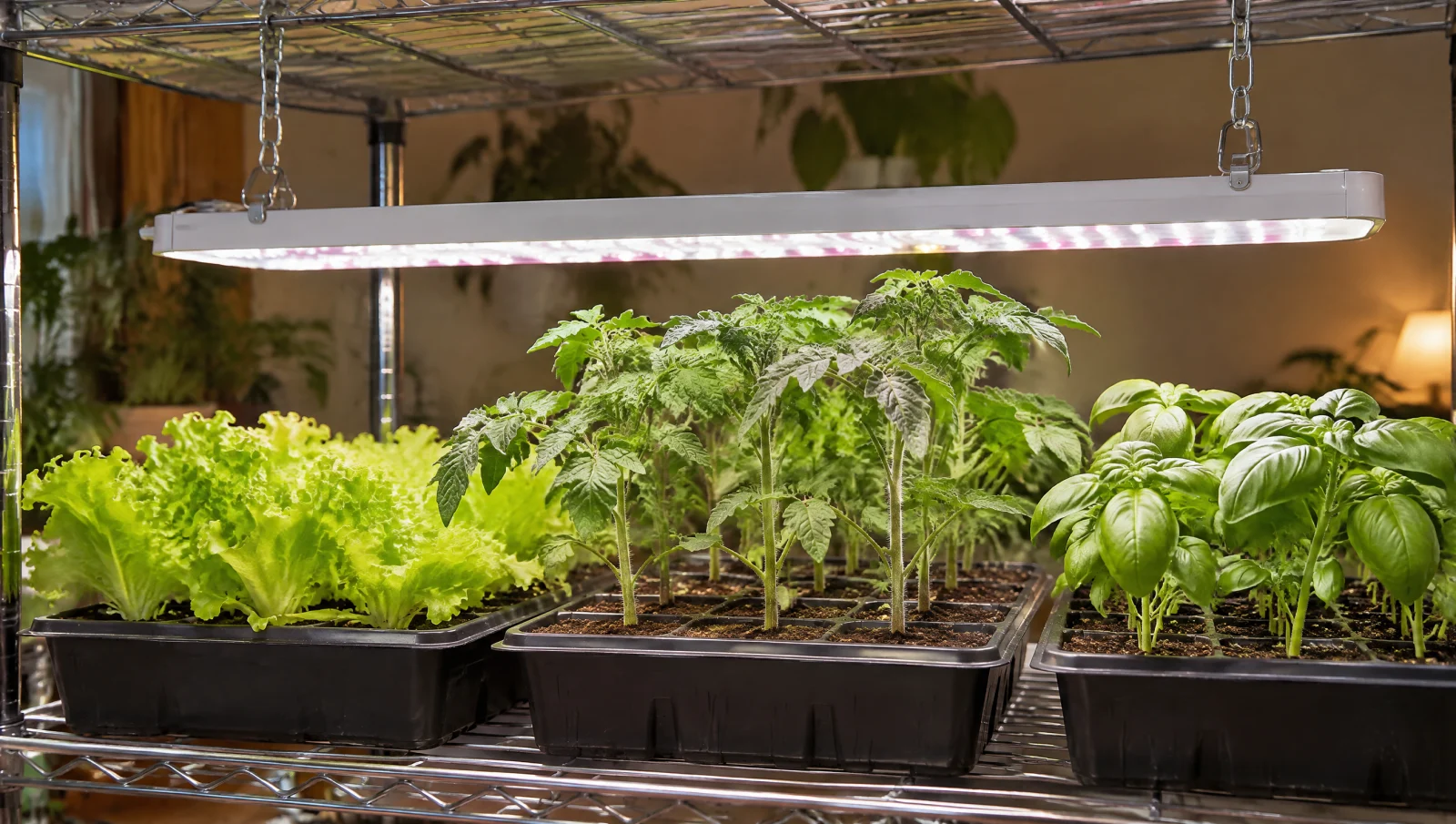

How far should grow lights be from plants? Keep fluorescent tubes about 4–12 inches above the leaves and most LED fixtures about 8–24 inches away, then raise the light as plants grow; hot HID lamps need considerably more distance.
Last updated: November 2026 · Sources: Iowa State, University of New Hampshire, Virginia Tech, University of Minnesota, University of Missouri, University of Kentucky and University of Vermont Extension.
Key Takeaways
- Seedlings do best 4–6 inches below fluorescent fixtures and about 8–12 inches below LED fixtures — Iowa State Extension.
- For general indoor growing, fluorescents go 6–12 inches from the foliage and most LEDs 12–24 inches — Iowa State Extension.
- Moving a fluorescent lamp from 18 to 9 inches roughly doubles the light the plants receive — University of Kentucky.
- One LED light bar measured by UNH Extension needed 8 hours a day at 8 inches but 16 hours at 20 inches to give seedlings the same daily light — University of New Hampshire.
- Suggested daily light integrals run from 5–10 mol/m²/day for seedlings to 20–30 for tomatoes and cucumbers — Virginia Tech.
- Browned leaf edges suggest the light is too close; lanky seedlings suggest it is too high — University of Vermont.
How far should grow lights be from plants, by light type?
The right distance depends mainly on how bright and how hot the fixture is. Dimmer, cooler fluorescent tubes must sit close to the leaves; brighter LEDs can hang a little higher; and high-intensity discharge (HID) lamps, which run very hot, go highest of all. Extension guidance lands in these ranges:
| Light type | Seedlings | Established plants | Heat risk |
|---|---|---|---|
| Fluorescent tubes (T5, T8, shop lights) | 4–6 in (Iowa State); under 1 ft (UNH) | 6–12 in from the foliage | Low, except near the ballast; T5 HO tubes run warmer |
| LED shop fixtures and grow lights | 8–12 in (Iowa State) | 12–24 in from the foliage | Low |
| HID (metal halide, high-pressure sodium) | Rarely used for seedlings at home | “Increased considerably” over fluorescent; follow the maker’s PPFD chart | High — radiant heat can burn plants |
| Incandescent bulbs | Not recommended | Must sit well away from leaves | High, with little useful light |
The fluorescent and LED figures come from Iowa State Extension. The HID guidance is from the University of Missouri, which gives a general rule of 6–12 inches for artificial light and says HID lamps need considerably more distance because of their intensity and heat. Extension sources do not give one fixed number for HID, because output varies so much between lamps.
4–6 influorescent to seedlings (Iowa State)
8–12 inLED to seedlings (Iowa State)
12–24 inLED to established plants (Iowa State)
~2×light when a fluorescent goes from 18 to 9 in (Univ. of Kentucky)
Why does grow light distance matter so much?
Distance matters because light intensity drops quickly as a fixture moves away from the leaves. The University of Kentucky explains that moving a fluorescent lamp from 18 inches to 9 inches gives plants about twice as much light, and moving it to 4½ inches doubles it again.
The University of New Hampshire gives a practical example: one commercially available LED light bar it measured would need to run 8 hours a day mounted 8 inches above seedlings, but 16 hours a day mounted 20 inches above them, to deliver the same total light. In other words, a light hung too high can quietly halve what your plants receive.
The catch is that closer is not always better. Plants exposed to too much light can end up with scorched and bleached leaves, notes the University of Minnesota, and hot fixtures can burn foliage outright. The best height is the closest one that does not stress the plant.
How much light do seedlings and vegetables actually need?
Plants respond to the total light they get in a day, called the daily light integral (DLI), measured in moles of light per square meter per day. Virginia Tech Extension calculates DLI from two numbers: the light intensity at the top of the plants (PPFD, in µmol/m²/s) and how many hours the light runs. For example, an LED delivering 200 µmol/m²/s for 16 hours gives a DLI of about 11.5.
Using Virginia Tech’s suggested DLI ranges, here is the canopy-level intensity each crop needs if the grow light is its only light source and runs 16 hours a day:
| Crop | Suggested DLI (mol/m²/day) | PPFD needed at 16 h/day (µmol/m²/s) |
|---|---|---|
| Seedlings and cuttings | 5–10 | about 87–174 |
| Microgreens | 9–12 | about 156–208 |
| Lettuce | 12–17 | about 208–295 |
| Spinach | 14–20 | about 243–347 |
| Basil | 15–25 | about 260–434 |
| Tomato, cucumber, zucchini | 20–30 | about 347–521 |
The PPFD column is simple arithmetic from Virginia Tech’s formula (DLI × 1,000,000 ÷ hours ÷ 3,600). For comparison, the University of Minnesota describes low light as 50–150 µmol/m²/s, medium light as 150–250 and high light as 250–450. That is why a basic shop light hung close is fine for seedlings and greens, while fruiting tomatoes and cucumbers need a much stronger fixture to grow well indoors.
Tip: Distance and hours work together. If you cannot lower a light any further without heat damage, the other levers are a brighter fixture, more fixtures, reflectors, or a longer — but not continuous — daily run time.
How do you set the right grow light height step by step?
Step 1 — Start from the extension range for your fixture
Hang fluorescent tubes 4–6 inches above seedlings and LED fixtures 8–12 inches above them, per Iowa State. For older plants, use 6–12 inches for fluorescents and 12–24 inches for LEDs. If the manufacturer publishes recommended heights, the University of Vermont advises following them.
Step 2 — Check the PPFD map if your light has one
The University of Missouri recommends checking a fixture’s PPFD distribution map, or measuring with a quantum sensor, to confirm it gives the right intensity at the height you plan to use. It suggests avoiding lights whose makers publish no spectrum graph or PPF/PPFD data, and focusing on PAR output rather than lumens or Kelvin ratings.
Step 3 — Make the height adjustable
Hang fixtures on adjustable chains or cables so you can raise them as plants grow, or set trays on blocks or bricks that you remove over time, as Iowa State suggests. Keep the gap measured from the top leaves, not the soil.
Step 4 — Put the lights on a timer
Iowa State recommends 14–16 hours a day for seedlings; the University of Vermont suggests 16–18 hours at 65–75°F, and stresses that plants need a dark period, so do not run lights continuously. For other indoor plants, Iowa State advises keeping lights on no less than 10 and no more than 16 hours a day for home gardeners.
Step 5 — Watch the plants and adjust
Without a light meter, the plants tell you whether the height is right. Raise the light if leaf edges brown or bleach; lower it if seedlings stretch. Fluorescent tubes give less light at the ends than in the center, the University of Missouri notes, so rotate trays between the middle and the edges for even growth.
What are the signs a grow light is too close or too far?
A light that is too far produces leggy plants; a light that is too close causes browning, bleaching or heat damage. Here is how to read the symptoms:
| Symptom | Likely cause | Fix |
|---|---|---|
| Tall, thin seedlings with long gaps between leaves | Light too far away or too weak | Lower the light, add fixtures or lengthen the timer (max 16–18 h) |
| Seedlings leaning toward a window | Not enough artificial light reaching them | Bring the fixture closer and center trays under it |
| Brown leaf tips or edges | Light too close or too hot | Raise the light a few inches; check canopy temperature |
| Bleached, pale or scorched patches on top leaves | Too much light intensity | Raise the light or shorten the run time |
| Plants at tray edges smaller than in the middle | Fluorescent tubes dimmer at the ends | Rotate trays; add side reflectors |
| Some plants dry out or burn faster than others | Hot spot under a fluorescent ballast | Move those plants or shift the fixture |
The symptom descriptions come from the University of Vermont, the University of Minnesota and UNH, which also warns that once a stem has stretched, adding light will not shrink it back, though it can prevent further stretching.
Should grow light distance change as plants grow?
Yes. The distance is measured from the top of the plants, so as seedlings grow, the gap shrinks and the light needs to move up. Iowa State notes that you will need to raise the fixture, or lower the plants, as they grow to keep the gap in range.
Needs also change with the crop. Leafy greens such as lettuce, parsley and cilantro have moderate light needs, while fruiting crops such as tomatoes and peppers need far more. Virginia Tech notes that fruiting crops can need nearly double or triple the DLI of some leafy greens. If you start tomatoes indoors, keep the light close through the seedling stage, then harden them off and move them outside — our tomato life cycle guide shows when each stage happens.
Which grow light type is easiest to position for home growers?
LED fixtures are the easiest for most home growers because they run cool, hold their output and can hang a little higher. Iowa State notes that LEDs do not fade over time the way fluorescent bulbs do, which is part of why they can sit farther from plants, and that fluorescent tubes should be replaced every one to two years as their intensity falls.
In tight setups such as stacked shelves, the University of Missouri says high-pressure sodium lamps are not an option because their radiant heat could burn plants, while LED and fluorescent lights can sit close without burning them. The same logic applies to compact soilless systems such as a DIY aeroponic garden, where plants grow close together under a fixed light.
Once your transplants are ready, they can move outdoors into containers or a well-prepared bed — see how to fill a raised garden bed and when to plant lettuce for timing.
Frequently asked questions
How far should an LED grow light be from seedlings?
About 8–12 inches, according to Iowa State Extension. Raise it as the seedlings grow, and follow the manufacturer’s height or PPFD chart if one is provided.
How far should fluorescent lights be from seedlings?
About 4–6 inches. Fluorescent tubes give off less light than LEDs, so they must sit close to the leaves; UNH Extension says shop lights should stay less than one foot above seedlings.
Can a grow light be too close to plants?
Yes. Too much light or heat can brown leaf edges and cause scorched, bleached leaves. Raise the light a few inches if you see these signs.
Why are my seedlings leggy under a grow light?
Usually the light is too far away, too weak or not on long enough. Lower it, add light or lengthen the daily run time. Stretched stems will not shrink back, but more light prevents further stretching.
How far should HID grow lights be from plants?
Considerably farther than fluorescent lights, because HID lamps are very bright and hot. There is no single extension figure; use the manufacturer’s PPFD chart or a light meter to set the height.
How many hours a day should grow lights be on for seedlings?
Iowa State Extension suggests 14–16 hours a day and the University of Vermont 16–18 hours. Always give plants a dark period; do not run lights 24 hours.
Does moving a grow light closer really make a difference?
Yes. The University of Kentucky notes that moving a fluorescent lamp from 18 to 9 inches roughly doubles the light plants receive, and UNH found one LED bar needed twice the hours at 20 inches as at 8 inches.