

Ethan Brooks
Focused on sustainable practices, careful seed selection, and hands-on experience, our family work closely with nature to produce quality harvests while continuously learning and improving each year..
Latest Posts
- Top 8 Urban Farms in the World: Rooftops, Vertical Farms and Community Gardens

- Zigg Design Specs: Build a Zig-Zag Rain Gutter Aquaponic Garden
- Top 5 Home Aquaponics Kits: From Desktop Tanks to Backyard Systems
- DIY Aquaponics: How to Build a Backyard Fish and Vegetable System
- Fish-Friendly Fertilizers: What Is Safe to Add to Aquaponics and Garden Ponds
Archive
Tags
Social Links
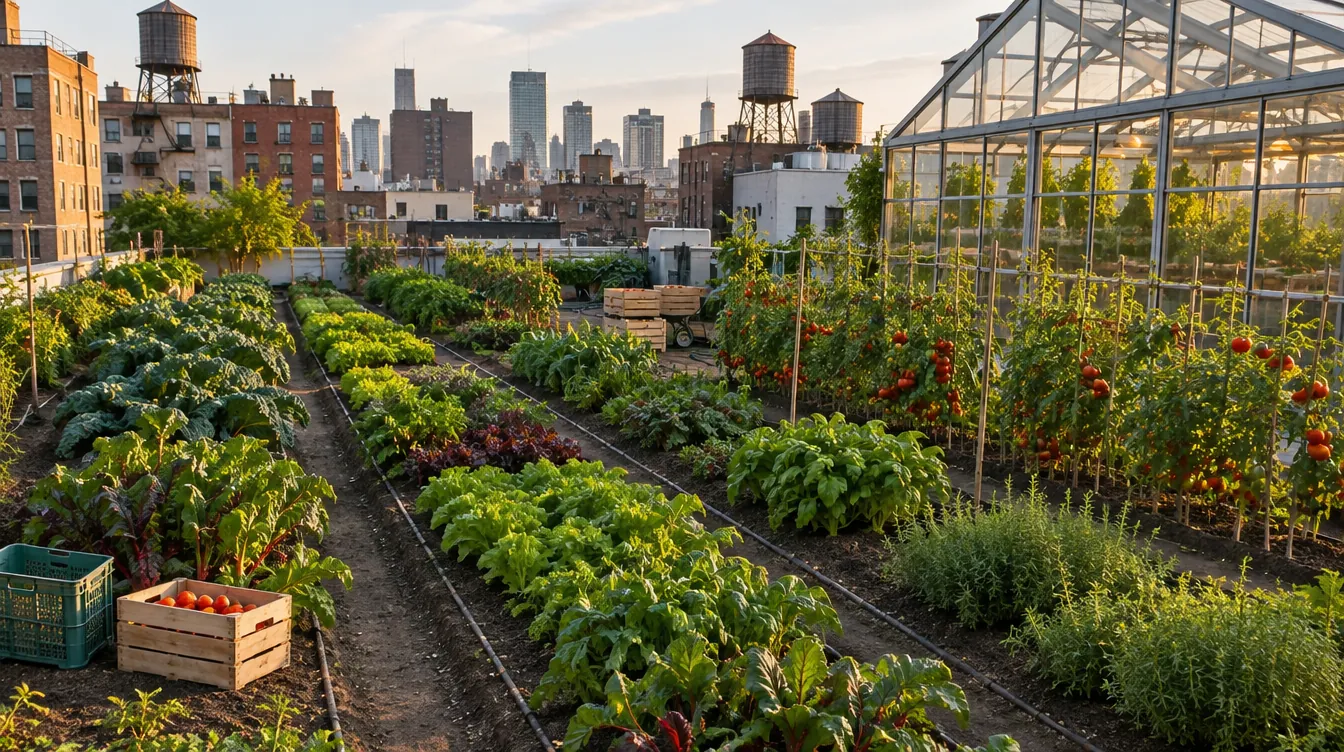

The world’s most important urban farms grow food on rooftops, in greenhouses on top of supermarkets, in towers of hydroponic racks and on reclaimed city land. These eight show the main ways cities are producing food today, from Montreal’s rooftop greenhouses to a five-storey vertical farm in Singapore and a community garden in a Berlin cemetery. The figures come from the farms themselves or from official and news sources listed at the end; check a farm’s own website before planning a visit.
At a glance
| Farm | City | Type | Key number |
|---|---|---|---|
| Lufa Farms | Montreal, Canada | Rooftop greenhouses | Five rooftop greenhouses; the largest is 163,800 sq ft |
| Nature Urbaine | Paris, France | Rooftop aeroponic and hydroponic farm | Nearly 14,000 m² of roof |
| Greenphyto (Hydrogreens) | Singapore | Indoor vertical farm | 23.3 m tall, five storeys, capacity of 2,000 tonnes a year |
| Gotham Greens | United States | Urban and rooftop greenhouses | 1.8 million sq ft (nearly 40 acres) |
| Brooklyn Grange | New York, USA | Rooftop soil farms | 5.6 acres; about 80,000 lb of vegetables a year |
| Prinzessinnengarten | Berlin, Germany | Community garden | 7.5 hectares in a city cemetery |
| Michigan Urban Farming Initiative | Detroit, USA | Agrihood on vacant city land | Announced as the first sustainable urban agrihood in the US |
| Sky Greens | Singapore | Rotating vertical towers | 9 m towers turned by a water-driven pulley |
1. Lufa Farms, Montreal: rooftop greenhouses at scale
Lufa Farms, founded in 2009, opened its first commercial rooftop greenhouse in Montreal’s Ahuntsic district in 2011. It now runs five rooftop greenhouses: Ahuntsic (31,000 sq ft, 2011), Laval (43,000 sq ft, 2013), Anjou (63,000 sq ft, 2017), Ville Saint-Laurent (163,800 sq ft, 2020) and Marché Central (127,000 sq ft, 2024), plus an indoor farm. Lufa describes its Ville Saint-Laurent greenhouse as the largest rooftop greenhouse in the world.
Why it matters: Lufa shows that rooftop farming can be a business at city scale. It sells through weekly online baskets, delivering around 20,000 a week to more than 500 pick-up points across Quebec.
2. Nature Urbaine, Paris: Europe’s giant rooftop farm
Opened in spring 2020 on the roof of the Paris Expo Porte de Versailles exhibition centre, Nature Urbaine covers nearly 14,000 m² of roof. It grows tomatoes, strawberries, lettuces, radishes, chard, cucumbers, aubergines, herbs and edible flowers in soilless aeroponic columns and hydroponic gutters, without pesticides.
Why it matters: it puts vertical aeroponic growing on a huge public rooftop in the middle of a capital city. Visitors can tour it from April to September. Our DIY aeroponics guide explains the same growing method at home scale, and our Zigg gutter garden uses the gutter method.
3. Greenphyto (Hydrogreens), Singapore: the world’s tallest indoor vertical farm
Officially opened on 7 January 2026 in Jurong West, Greenphyto’s S$80 million farm is a 23.3-metre-tall, 118-metre-long, five-storey hydroponic structure, reported as the world’s tallest indoor vertical farm. It is designed to grow up to 2,000 tonnes of vegetables a year and currently produces about 200 tonnes of greens such as kai lan and lettuce, sold under the Hydrogreens brand.
Why it matters: Singapore imports most of its food, and farms like this are part of its push to grow more locally on very little land.
4. Gotham Greens, United States: greenhouses on city roofs
Founded in Brooklyn in 2009, Gotham Greens completed its first greenhouse on a Greenpoint rooftop in 2011, which it calls the first commercial-scale rooftop greenhouse in the US. It has since expanded to greenhouses in nine states, and its 2023 expansion brought total production to 1.8 million square feet, nearly 40 acres, of leafy greens and herbs.
Why it matters: Gotham Greens took the rooftop greenhouse from a single pilot to a national grocery brand, at a time when many indoor farming companies have closed.
5. Brooklyn Grange, New York: rooftop soil farming
Brooklyn Grange was co-founded in April 2010 and grows in real soil on rooftops: about 5.6 acres in total, producing roughly 80,000 pounds of organic vegetables a year. Its Sunset Park farm, opened in 2019, spans a 140,000 sq ft roof and can manage more than 175,000 gallons of stormwater in a single rainfall, according to New York City’s Department of Environmental Protection.
Why it matters: it shows that rooftop farms do more than grow food. They also soak up stormwater that would otherwise overwhelm city sewers.
6. Prinzessinnengarten, Berlin: the community garden that moved
Prinzessinnengarten began in 2009 as a mobile garden of raised beds on an almost 6,000 m² brownfield site at Moritzplatz in Kreuzberg. After ten years it moved to a 7.5-hectare section of the New St. Jacobi Cemetery in Neukölln, run since 2020 by the Prinzessinnengarten Kollektiv. There are no private beds: everyone gardens together, and the garden hosts workshops on biodiversity and climate adaptation. A neighbourhood garden continues at Moritzplatz.
Why it matters: it is a model for community-run urban farming on land that is only temporarily available.
7. Michigan Urban Farming Initiative, Detroit: the agrihood
Founded in 2011 by two University of Michigan students, the Michigan Urban Farming Initiative (MUFI) farms vacant land in Detroit’s North End. In 2016 it announced what it described as the first sustainable urban “agrihood” in the United States: a neighbourhood built around a working farm, with food grown for local residents.
Why it matters: MUFI uses farming to rebuild a neighbourhood, not just to sell produce.
8. Sky Greens, Singapore: vertical farming without electricity-hungry racks
Sky Greens began commercial production in 2012 with a low-energy idea: A-shaped aluminium towers about 9 metres tall, each with 38 growing troughs that rotate slowly so every plant gets sunlight. The rotation is driven by a water-powered pulley; according to EcoWatch’s 2015 report, only about 0.5 litres of water turns a 1.7-tonne tower, and the water is recycled.
Why it matters: it was one of the world’s first commercial vertical farms, and it uses daylight and gravity instead of the heavy lighting and air-conditioning that made many later indoor farms too expensive to run.
What these farms have in common
- They grow what travels badly. Leafy greens, herbs, tomatoes and strawberries lose quality fast in transport, so growing them close to buyers pays off.
- They use space cities already have: roofs, vacant lots, cemeteries and industrial buildings.
- Greenhouses and soil have outlasted high-tech indoor farms. Several heavily funded indoor vertical farming companies have closed in recent years, while daylight-based rooftop greenhouses and soil farms have kept growing.
- Most also do something besides selling food: stormwater control, education, community building or food security.
Start your own urban farm
You don’t need a warehouse roof to grow food in a city. A balcony gutter garden, a small aquaponics system or an aeroponic tote can produce fresh greens all season. Start with our guides to DIY aquaponics, DIY aeroponics and the Zigg rain gutter garden, or compare ready-made home aquaponics kits.
Frequently asked questions
What is the largest rooftop farm in the world?
It depends on how you measure. Lufa Farms describes its 163,800 sq ft Ville Saint-Laurent greenhouse in Montreal as the largest rooftop greenhouse in the world, while Nature Urbaine in Paris covers nearly 14,000 m² (about 150,000 sq ft) of open rooftop.
What is the tallest vertical farm?
Greenphyto’s 23.3-metre, five-storey hydroponic farm in Singapore, opened in January 2026, was reported as the world’s tallest indoor vertical farm.
Can you visit urban farms?
Some offer tours. Nature Urbaine in Paris runs visits from April to September, and Prinzessinnengarten in Berlin holds open gardening days. Check each farm’s website before you go.
Are urban farms profitable?
Some are and some are not. Rooftop greenhouses and soil farms that sell direct to customers, like Lufa Farms and Brooklyn Grange, have lasted more than a decade, while several high-cost indoor vertical farms have shut down.
Sources
- Lufa Farms, “Our greenhouses” (montreal.lufa.com/farms); Wikipedia, “Lufa Farms”
- Sortiraparis, “Nature Urbaine – NU Paris” (visit details and farm facts)
- Mothership.sg, “World’s tallest indoor vertical farm” (January 2026)
- Gotham Greens, “Our story” (gothamgreens.com)
- Wikipedia, “Brooklyn Grange”; NYC Department of Environmental Protection, news release 19-065 (August 2019)
- Berlin.de, “Prinzessinnengarten” (community gardens)
- Wikipedia, “Michigan Urban Farming Initiative”
- EcoWatch, “World’s First Hydraulic-Driven Vertical Farm” (September 2015)