

Ethan Brooks
Editor of FarmXchange. Ethan plans, edits and updates our growing guides, checking them against university extension and USDA sources. How we work
Latest Posts
- How to Fill a Raised Garden Bed: Best Soil Mix, Amounts and Steps

- Top 8 Urban Farms in the World: Rooftops, Vertical Farms and Community Gardens
- Zigg Design Specs: Build a Zig-Zag Rain Gutter Aquaponic Garden
- Top 5 Home Aquaponics Kits: From Desktop Tanks to Backyard Systems
- DIY Aquaponics: How to Build a Backyard Fish and Vegetable System

Archive
Tags
Social Links
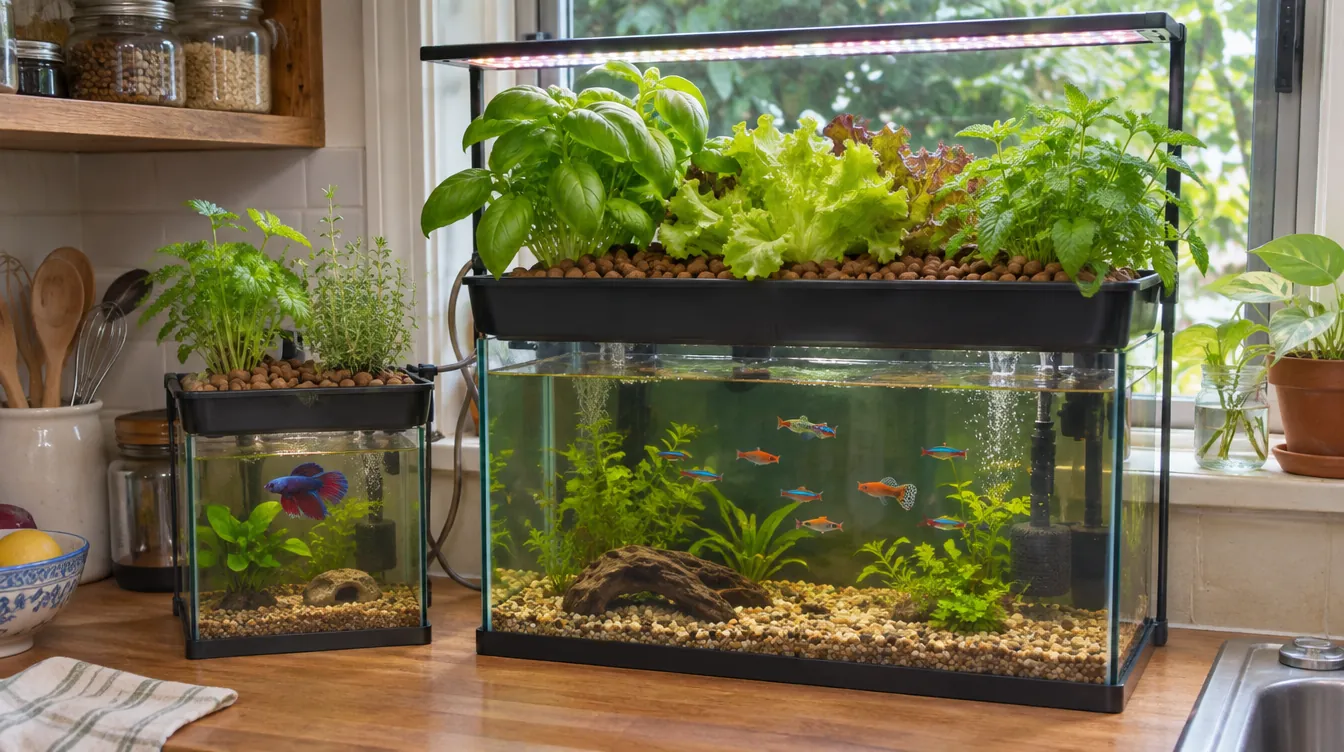

The best home aquaponics kit depends on what you want from it: a small desktop tank grows a few herbs above a single fish, while a full backyard system can feed a family. We picked five kits that are on sale now, from a $40 planter tank to a 100-gallon raft system, and checked each one’s specs, price and limits. If you would rather build your own, see our DIY aquaponics guide.
Prices were checked on 25 November 2026 at the retailer or maker named. They change often, so confirm before you buy.
Quick comparison
| Kit | Fish tank | Grows | Price | Best for |
|---|---|---|---|---|
| AquaSprouts Garden | Your own 10-gallon aquarium | A 28-inch media grow bed | $175.75 (Chewy) | Best overall for beginners |
| Back to the Roots Water Garden | 3 gallons, included | A small tray of herbs or microgreens | Check retailer | Kids and classrooms |
| Penn-Plax Aqua-Ponic Aquarium | 1.4 gallons, included | One planter of houseplants or herbs | $37.49 (Chewy) | Cheapest way to try the idea |
| Nelson and Pade Small Fry 1 | 18 gallons, included | 12 plant sites on a raft | $1,995 (maker) | A serious indoor food system |
| Nelson and Pade F5 | 100 gallons, included | 96 sq ft footprint of raft tanks | $5,038 plus shipping (maker) | Backyard or greenhouse food production |
1. AquaSprouts Garden: best overall for beginners
AquaSprouts turns a standard 10-gallon aquarium into an aquaponic garden. The kit sits on top of the tank and includes a grow bed, grow media, a submersible pump rated at 160 gallons per hour, a mechanical timer adjustable in 15-minute steps for flood-and-drain cycles, and a light bar. The unit measures 28 x 8 x 10 inches.
- Price: $175.75 at Chewy (list price $189.95).
- Fish: small freshwater species such as tetras, platies, guppies, danios and Corydoras.
- Good: a real media bed with flood-and-drain, the same method used in larger systems, so it teaches how aquaponics actually works.
- Watch out: the aquarium is not included. It has only a handful of reviews at Chewy (3.1 out of 5 from 7 ratings), and one buyer reported the light not working, so test everything on arrival.
2. Back to the Roots Water Garden: best for kids and classrooms
The Water Garden is a 3-gallon tank with a small grow bed on top. Back to the Roots includes a water pump, grow stones, gravel, seeds, water conditioner, natural fertilizer and fish food, plus a coupon for a betta fish and a free online aquaponics curriculum.
- Price: sold through Walmart, Lowe’s, Costco and others; check current pricing.
- Fish: designed for a single betta.
- Good: everything is in the box, and the curriculum makes it a good teaching tool.
- Watch out: the grow area is small, so expect a few herbs or microgreens rather than a harvest. Three gallons is at the low end for a betta, so keep up with water testing.
3. Penn-Plax Aqua-Ponic Aquarium: cheapest way to try it
The Penn-Plax tank is a 1.4-gallon plastic tank with a planter on top, measuring 8 x 8 x 10 inches. The kit includes the tank and ceramic planting material; there is no pump or light, and no plant.
- Price: $37.49 at Chewy.
- Good: very cheap and fits on a desk.
- Watch out: Penn-Plax markets it for bettas, small goldfish and minnows, but several reviewers point out that 1.4 gallons is too small for those fish; many keepers recommend at least 5 gallons for a betta. Treat it as a decorative planter, not a food-growing system.
4. Nelson and Pade Small Fry 1: best serious indoor system
Nelson and Pade is a long-established aquaponics company, and the Small Fry is its entry-level home system. The Small Fry 1 pairs an 18-gallon fish tank with a rotating circular raft holding 12 plants, all within a 32 x 32 inch footprint.
- Price: $1,995 from the maker.
- Includes: fish and filter tanks, a wooden stand, the plant raft, pump and plumbing, LED grow lights, starter fish food, 50 grow cubes, four seed packs, a fish net, test strips, manuals and an online introductory aquaponics course.
- Good: a complete, properly engineered system with lights and training.
- Watch out: a big price jump from the desktop kits. The Small Fry 2 ($2,995) adds a heater, aeration and a better test kit, and the Small Fry 3 ($3,995) triples the grow area to 36 plant sites.
5. Nelson and Pade F5: best for backyard food production
The F5 is a real small-farm system: one 100-gallon fish tank and two 4 x 6 foot raft tanks in a 6 x 16 foot (96 sq ft) footprint. Nelson and Pade suggest allowing a 12 x 20 foot space around it.
- Price: $5,038 from the maker, not including options, palleting or shipping.
- Includes: fish and filter tanks, raft tanks, water pump, plumbing and valves, air blower and aeration parts, stands, a heated seed germination kit and the book Aquaponic Food Production.
- Watch out: plant rafts, assembly, shipping and plumbing to your water supply and drain are not included. You will need a greenhouse or a warm climate for year-round growing.
How to choose a home aquaponics kit
- Decide what you want to harvest. Desktop kits grow a few herbs. To grow meaningful amounts of food you need a grow area measured in square feet, not inches.
- Check what is included. Some kits leave out the tank, the pump or the lights. Add those to the price.
- Size the tank for the fish. Small tanks swing quickly in temperature and water quality. Bigger is easier to keep stable.
- Look for flood-and-drain or aeration. Plant roots and the nitrifying bacteria both need oxygen.
- Plan for cycling. Every system needs about four weeks for beneficial bacteria to establish before it is safe for a full load of fish, according to Oklahoma State University Extension.
- Budget for test kits and supplements. You will test pH, ammonia, nitrite and nitrate regularly, and most systems need small additions of iron, calcium and potassium. See our guide to fish-friendly fertilizers.
Kit or DIY?
A kit saves time and gets the plumbing right. A DIY system costs less per square foot of growing space and is easier to expand. A good path for many people is to start with a desktop kit to learn the basics, then build a larger system once the fish and bacteria make sense.
Frequently asked questions
What is the best aquaponics kit for a beginner?
For most beginners, a kit with a real grow bed and a pump, such as the AquaSprouts Garden on a 10-gallon aquarium, is the best balance of price and learning value.
Can a home aquaponics kit feed a family?
Desktop kits cannot. Systems with a 100-gallon fish tank and dozens of square feet of raft area, like the Nelson and Pade F5, are designed for meaningful food production.
Which fish are best for a small aquaponics kit?
Small, hardy freshwater fish such as tetras, platies, guppies and danios suit 10-gallon kits. Edible fish such as tilapia need much larger tanks.
Do aquaponics kits need a grow light?
Indoors, yes, unless the kit sits in a very bright window. Most leafy greens and herbs need far more light than a typical room provides.
Sources
- Chewy product listings: AquaSprouts Garden 10-gallon and Penn-Plax Large Aquaponic Aquarium Tank 1.4-gallon (checked 25 November 2026)
- Lowe’s product listing: Back to the Roots Water Garden
- Nelson and Pade, Home Aquaponic Systems (aquaponics.com)
- Oklahoma State University Extension, “Nitrification and Maintenance in Media Bed Aquaponics”